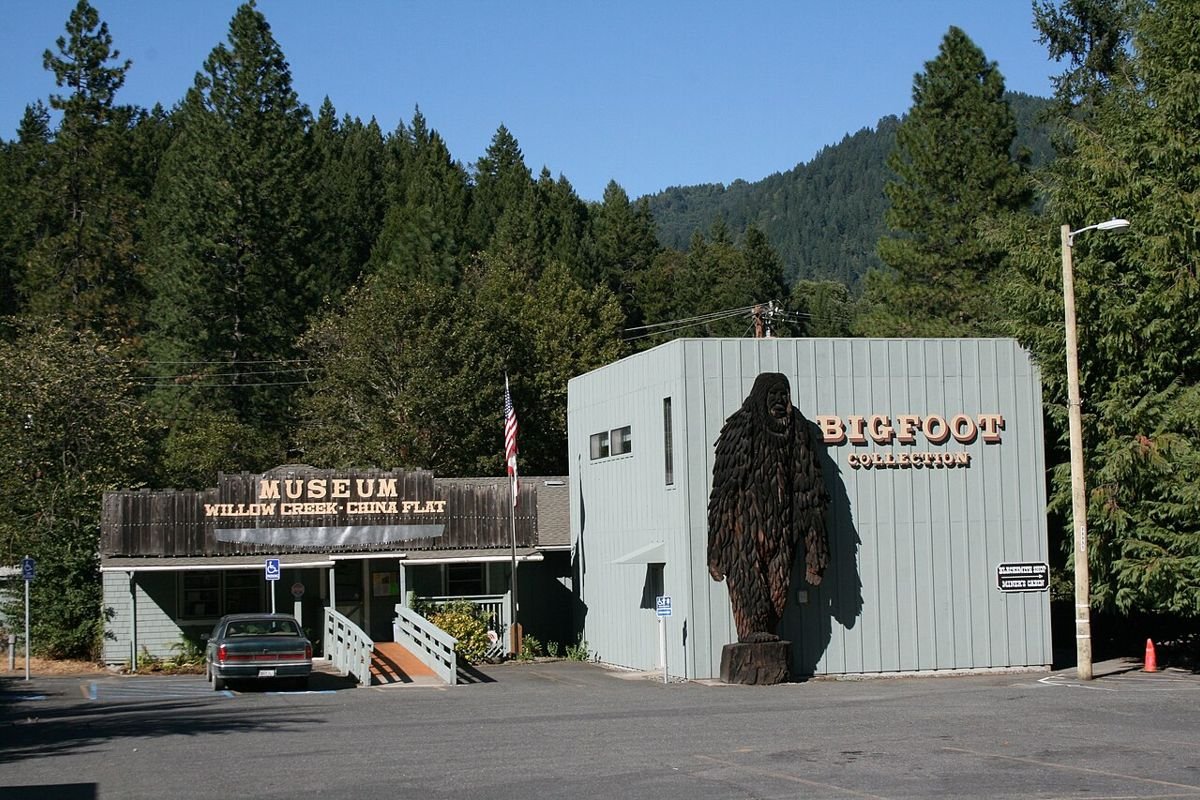
Overview
Bigfoot is the name North Americans give to a large, upright, ape-like creature said to live in deep forest. Witnesses usually describe something between six and nine feet tall, covered in black, brown or reddish hair, with broad shoulders, long arms and almost no neck. Many reports add a strong, foul smell. Footprints said to belong to it have been cast at up to 24 inches long.
The name Sasquatch reached English in 1929, when J.W. Burns wrote about 'hairy giants' for Maclean's magazine. He borrowed it from sasq'ets, a word in the Halq'emeylem language of the Sts'ailes people that means hairy man. Stories of wild, hairy giants appear in many Indigenous traditions across the continent, from Yokuts rock art in California to the Stone Giant tales of the Iroquois.
The name Bigfoot came later. In 1958 a road crew at Bluff Creek, California, found huge human-like tracks, and a local paper ran the story with the workers' nickname for the track-maker. Since then the creature has become a fixture of American culture. Researchers have logged more than 10,000 reports in the continental United States, about a third of them from the Pacific Northwest.
Scientists remain unconvinced. No body, skeleton or confirmed DNA has ever been produced, and several famous pieces of evidence have turned out to be hoaxes. Supporters answer that the forests are vast, the witnesses are many, and some evidence, such as the 1967 Patterson-Gimlin film, has never been fully explained to their satisfaction.
Timeline
- 1840Missionary Elkanah Walker records stories of giants near Spokane said to steal salmon from nets.
- 1924Miners near Mount St. Helens report a fight with 'ape-men' at what becomes Ape Canyon.
- 1929J.W. Burns introduces the word Sasquatch in Maclean's magazine.
- 1958Jerry Crew's road crew finds 16-inch tracks at Bluff Creek; the name Bigfoot spreads nationwide.
- 1967Roger Patterson and Bob Gimlin film a walking figure at Bluff Creek.
- 1969Skamania County, Washington, makes killing a Sasquatch a crime.
- 2002Ray Wallace's family says he made the 1958 tracks with carved wooden feet.
- 2008Two Georgia men claim to have a Bigfoot body in a freezer; it is a rubber costume.
- 2014An Oxford-led DNA study finds only known animals among hair samples sent in by researchers.
Reported sightings
Ape Canyon, Mount St. Helens, Washington
Summer 1924 (reported July 1924) On the record
A group of gold prospectors said tall, ape-like animals attacked their cabin near Mount St. Helens. Miner Fred Beck said he shot at one and saw it fall into a canyon. That night, they said, the creatures pelted the cabin with rocks and left huge footprints. The Oregonian carried the story in July 1924. Forest Service rangers who checked the site found nothing to back it up and showed how the tracks could be faked. Decades later a local group of pranksters claimed they were behind it.
Source: en.wikipedia.orgRuby Creek, British Columbia
1941 Told story
Jeannie Chapman said she and her three children fled their home when a giant, hair-covered figure came out of the woods. Her husband George later reported very large, human-shaped footprints and a damaged woodshed. The family said the visitor came back every night for about a week, and they eventually moved away for good. The account is a classic of early Sasquatch lore in Canada, though it rests on the family's word.
Source: en.wikipedia.orgBluff Creek road project, Six Rivers National Forest, California
Late August to October 1958 Proven hoax
Bulldozer operator Jerry Crew found a line of human-like footprints about 16 inches long around his crew's road work. He made a plaster cast and took it to Andrew Genzoli at the Humboldt Times, which ran a front-page photo of Crew holding it on October 6, 1958. The story went national and made Bigfoot a household word. In 2002, after the death of contractor Ray Wallace, his family showed carved wooden feet and said he had made the tracks as a prank. Crew himself is not accused of faking anything.
Source: en.wikipedia.orgBluff Creek, Northern California
October 20, 1967 On the record
Roger Patterson and Bob Gimlin, riding along a creek bed about 25 road miles northwest of Orleans, filmed a dark, upright figure walking away from them. It turns its head toward the camera in the most famous frame. The film runs about a minute. Supporters such as Grover Krantz and special-effects artist Bill Munns argue it could not have been faked in 1967. Skeptics point to Bob Heironimus, who said in 1999 that he wore the suit, though no suit has ever been produced.
Source: en.wikipedia.orgBlue Mountains, Oregon
1994 On the record
Paul Freeman, a former Forest Service worker, videotaped what he said was a Bigfoot in the Blue Mountains of northeast Oregon. He had earlier reported finding footprints that showed skin-ridge patterns, which some researchers took as hard to fake. The 'Freeman footage' is still argued over. Some reviewers find it convincing; others think it shows a person in a costume.
Source: en.wikipedia.orgLaurel-Snow State Natural Area, Dayton, Tennessee
March 2004 Investigated report
A camper woke around 3 a.m. feeling something approaching. About forty yards away at the top of the trail, he said, an upright figure six and a half to seven feet tall stood watching, with unusually wide shoulders. A second one then stepped out and moved to the side, as if circling the camp. When he swung a flashlight back, both were gone. The BFRO investigator who followed up described the witness as a credible state employee.
Source: bfro.netAllegheny National Forest, Pennsylvania
2007 Investigated report
The Bigfoot Field Researchers Organization released trail-camera photos it said might show a young Bigfoot. The Pennsylvania Game Commission looked at the same pictures and said they showed a bear suffering from mange. The case is a good example of how one image can be read very differently by researchers and wildlife officials.
Source: en.wikipedia.orgNorth Georgia mountains
June to August 2008 Proven hoax
Rick Dyer and Matthew Whitton, a Clayton County police officer, said they had found a Bigfoot body while hiking and were keeping it in a freezer. They went on the radio and held a news conference. When investigator Steve Kulls thawed the block in August 2008, he found a rubber foot. The 'body' was a costume. The pair later called it a big joke.
Source: cnn.comTorreya State Park, Florida
May 2012 On the record
Stacy Brown said he had an encounter in Torreya State Park and recorded the scene with a forward-looking infrared (heat-sensing) camera. The footage drew attention online and on television. As with most thermal recordings, viewers disagree on what the heat shape actually is.
Source: en.wikipedia.orgSan Bernardino Mountains, California
2017 On the record
Claudia Ackley said she filmed a Bigfoot and later sued the California Department of Fish and Wildlife for not recognizing the animal. A state investigator concluded she had seen a bear. Ackley went on to run a support group for people shaken by encounters until her death in 2023.
Source: en.wikipedia.orgEvidence
Patterson-Gimlin film (1967) Disputed
About 59.5 seconds of 16 mm film showing a large, dark figure walking at Bluff Creek. Supporters say its gait and muscle movement could not be faked with 1967 costume technology. Many academics say it adds nothing of scientific value, and a man named Bob Heironimus has claimed he wore the suit.
1958 Bluff Creek footprints Proven hoax
The 16-inch tracks found by Jerry Crew's crew gave Bigfoot its name. In 2002 Ray Wallace's family produced the carved wooden feet they say he used.
Ape Canyon attack (1924) Disputed
Miners' story of rock-throwing ape-men near Mount St. Helens. Rangers found no supporting evidence at the time, and local pranksters later claimed responsibility.
Georgia freezer body (2008) Proven hoax
A claimed Bigfoot corpse in a block of ice turned out to be a rubber costume. The men behind it admitted the hoax.
Sykes DNA study (2014) Explained
University of Oxford and Lausanne's Cantonal Museum of Zoology tested hair submitted as coming from anomalous primates. Every sample that yielded DNA matched a known animal, including bears, cows, horses, dogs, deer and raccoons; the only primate hair was human.
FBI hair analysis (1976-77) Explained
Researcher Peter Byrne sent hairs to the FBI, which reported they were of the deer family. The file was released in 2019.
Footprint casts with skin ridges Disputed
Some casts, such as those reported by Paul Freeman in the 1980s, appear to show dermal ridges. Supporters call them hard to fake; skeptics suggest casting artifacts or deliberate fakery.
2012 'Ketchum' DNA paper Disputed
A Texas lab claimed Sasquatch was a human hybrid. The paper failed peer review at established journals and was published in a newly created online journal.
What each side says
What witnesses and researchers report
Witnesses come from every walk of life, including hunters, foresters, police officers and families on road trips, and their descriptions are remarkably consistent: very tall, heavily built, upright, covered in hair, and fast. Researchers point out that many people who report sightings have nothing to gain and often a lot to lose in ridicule.
Investigators such as the BFRO follow up reports with interviews and site visits. They argue that the sheer number of reports over more than a century, combined with Indigenous traditions of hairy giants that predate the modern legend, suggests something real is being seen. Supporters of the Patterson-Gimlin film also point to its natural-looking gait and the difficulty of building such a suit in 1967.
What skeptics and scientists suggest
Scientists note that a breeding population of large primates would leave bodies, bones, roadkill and clear DNA, and none has been found. Most physical evidence has been explained as known animals or has been exposed as hoaxes, from the 1958 tracks to the 2008 Georgia costume.
The leading explanation for honest sightings is the black bear. Bears can stand five to seven feet tall on their hind legs, and a 2009 study found that Bigfoot reports closely match black bear habitat. Other suggestions include escaped apes, people in costume, and the brain's habit of seeing faces and figures in shadows and foliage.
Open questions
- Who, if anyone, was inside the 'suit' in the Patterson-Gimlin film?
- Why have no bones or bodies been found despite thousands of reports?
- How much of the sighting record reflects black bears, especially bears with mange?
Visiting
Where: Bluff Creek and Willow Creek area, Six Rivers National Forest, northern California; the Bigfoot Scenic Byway (an 88-mile stretch of State Route 96); Mount St. Helens' Ape Canyon in Washington.
Access: Bluff Creek is remote national forest reached by logging roads; check road conditions. Ape Canyon is reached by trail on Mount St. Helens. Skamania County, Washington, has declared itself a Sasquatch refuge.
Events: Bigfoot festivals and museums are common. In the Southeast, the Expedition: Bigfoot! museum in Cherry Log, Georgia, and the Smoky Mountain Bigfoot Festival in Townsend, Tennessee (first Saturday in May) are popular stops.
Did you know?
- In 1969 Skamania County, Washington, made killing a Sasquatch a felony; in 1984 it softened the law and declared the whole county a Sasquatch refuge.
- The Yokuts 'Hairy Man' petroglyphs at Painted Rock on the Tule River Reservation are estimated to be about 1,000 years old.
- The Unicode Consortium announced a 'hairy creature' emoji in 2025.
- Two of the hair samples in the 2014 study first matched an ancient polar bear, but they came from the Himalayas, not North America.
Sources
- Bigfoot - Wikipedia
- Patterson-Gimlin film - Wikipedia
- Ape Canyon - Wikipedia
- Bigfoot claim a fake, ex-enthusiast says - CNN
- Bigfoot, Yeti? Hair Samples Match DNA from Paleolithic Polar Bear, Known Mammals - Sci.News
- MacLeod, commentary on Sykes et al., Proc. R. Soc. B (2014)
- BFRO Report #20231
- Expedition: Bigfoot! museum