Overview
Willow Creek is a small community in eastern Humboldt County, California, where Highway 299 meets Highway 96 near the Trinity River. It had 1,720 residents in the 2020 census. The surrounding mountains of the Six Rivers National Forest are among the most storied Bigfoot country anywhere, and the town has leaned into that reputation for decades.
Willow Creek calls itself the Bigfoot Capital of the World. It sits about 50 miles south of the Bluff Creek site where Roger Patterson and Bob Gimlin shot their famous film in 1967, and the road north toward that country, Highway 96, is signed as the Bigfoot Scenic Byway. For many road-trippers, Willow Creek is the gateway to the whole legend.
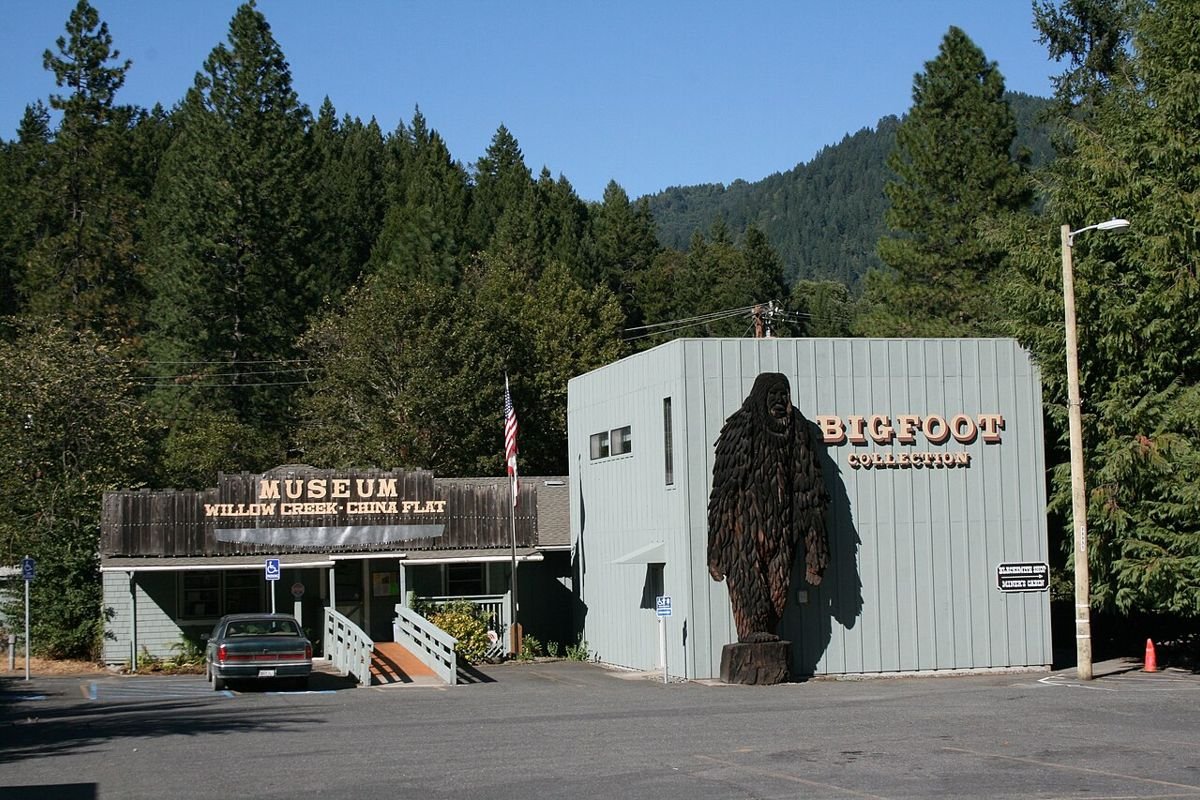
The town's local museum houses a dedicated Bigfoot collection, and the community holds an annual Bigfoot Daze celebration. Local businesses carry the theme everywhere, and the chamber of commerce links visitors straight to the Bigfoot Field Researchers Organization so they can report what they see.
Sightings in the hills around the town go back well before the Bigfoot name existed. BFRO files include hunters' night encounters from the early 1960s and tracks found by hikers in the 2000s. In 2013, filmmaker Bobcat Goldthwait set his found-footage horror film Willow Creek here, sending a believer and a skeptic from the town out to the film site.
Visiting
Where: Willow Creek, Humboldt County, CA, at the junction of Highways 299 and 96, about 30 miles from Eureka.
Access: The town, its museum and its Bigfoot-themed shops are open to the public. Highway 96 north, the Bigfoot Scenic Byway, leads toward Hoopa, Weitchpec, Orleans and the Bluff Creek country. The Hoopa Valley Reservation, just north of town, is tribal land: stay on public highways and respect tribal rules. Forest roads beyond are remote, gravel and often without phone signal.
Events: Bigfoot Daze, an annual community festival (Wikipedia says September; the chamber lists a 2027 event page). The Willow Creek-China Flat Museum has a Bigfoot collection.
Timeline
- 1958Footprints found by road crews in the Six Rivers National Forest give Bigfoot its name.
- April 1961Bear hunters near Willow Creek report a large creature circling their tent at night (BFRO).
- Oct 20, 1967The Patterson-Gimlin film is shot at Bluff Creek, about 50 miles north.
- 2013Bobcat Goldthwait's film Willow Creek is shot in the town and surrounding forest.
Reported sightings
High dirt road near Willow Creek, on or near the Hoopa Valley Reservation
April 1961 Investigated report
Two bear hunters camped on a remote mountain road said something large circled their tent, breathing loudly and stepping on brush, then gave a high scream lasting about five seconds from 50 to 100 yards away. No tracks or smell were found in the morning. The witness only linked it to Bigfoot years later, after seeing the Patterson film. BFRO rated it Class B.
Source: bfro.netEast side of the Hoopa Valley Reservation
Spring 1978 Investigated report
A prospector reported a possible morning encounter on the east side of the Hoopa Valley Reservation, north of Willow Creek. The BFRO lists it as a Class B report. Only the report's title was reviewed for this dossier.
Source: bfro.netBluff Creek near Louse Camp (reached via Willow Creek and Orleans)
June 21, 2003 Investigated report
A hiker found a single footprint 16 inches long and nearly 6 inches wide at the heel in an old mud puddle near broken trees. A BFRO investigator viewed the hiker's video and judged it to be the track of a large biped. The BFRO files it under reports near Willow Creek.
Source: bfro.netHoopa Valley Reservation
June 2021 Investigated report
The BFRO lists a Class B report of possible 'Ohio howls', a type of long, rising call that researchers associate with Bigfoot, heard on the Hoopa Valley Reservation just north of Willow Creek. Only the listing title was reviewed for this dossier.
Source: bfro.netEvidence
Regional footprint casts Disputed
Casts from the surrounding forests, including the 1967 Bluff Creek casts, are part of the region's Bigfoot story and are the kind of material collected by the local museum.
Night vocalizations Unexplained
Screams, grunts and howls reported by hunters and campers in the hills around town.
What each side says
What witnesses and researchers report
Residents and visiting researchers say the steep, thinly populated forests around Willow Creek could easily hide a large animal, and that reports from hunters, prospectors and campers have come in for more than sixty years.
Believers note that some witnesses, like the 1961 bear hunters, had never heard of Bigfoot when they had their experience and only made the connection later.
What skeptics and scientists suggest
Skeptics point out that the region's most famous early evidence, the 1958 tracks, was claimed in 2002 as the work of prankster Ray Wallace, and that the Patterson-Gimlin film remains contested.
They add that night sounds and broken trees have many ordinary causes, including black bears, elk and owls, and that a town that markets itself as Bigfoot's capital naturally draws people primed to find him.
Open questions
- Do reports around Willow Creek cluster by season or by road access?
- Why do the hills between the Trinity and Klamath rivers produce so many reports?
Did you know?
- The Willow Creek chamber of commerce links visitors directly to the BFRO's Humboldt County sighting form.
- The 2013 film Willow Creek was directed by comedian Bobcat Goldthwait.