Overview
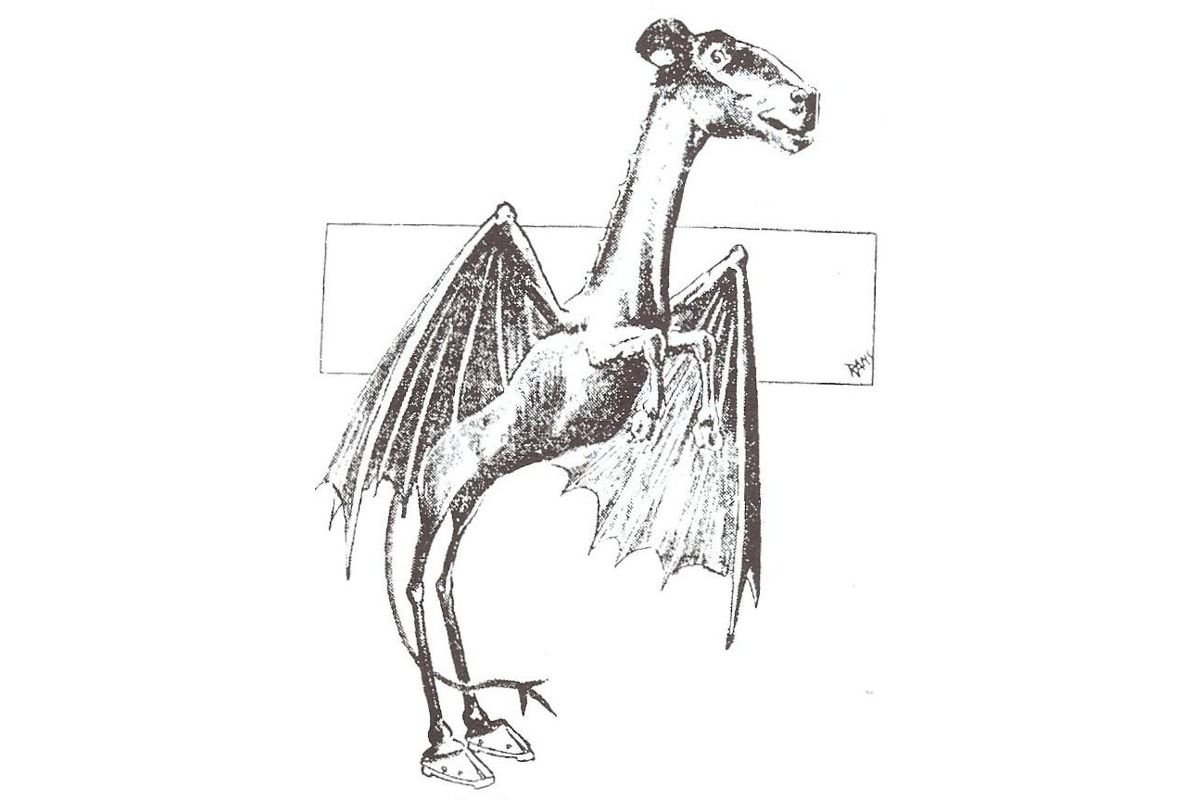
The Jersey Devil is New Jersey's own monster, said to haunt the Pine Barrens, a huge stretch of pine forest and cedar swamp in the south of the state. Descriptions usually include a horse- or goat-like head, leathery bat wings, horns, clawed hands, hooved legs and a forked tail. It is often said to walk upright and to give off a terrible scream.
The best-known origin story says that in 1735 a woman known as Mother Leeds, learning she was pregnant with her thirteenth child, cursed it and wished it were the devil. The baby was born, changed into a winged monster and flew up the chimney into the pines. There was a real Leeds family in the area, and a 1736 will names twelve children.
Historian Brian Regal argues the legend grew out of colonial politics. Almanac publisher Titan Leeds feuded with Benjamin Franklin, and the Leeds family crest showed a wyvern, a winged dragon. Over time, the 'Leeds Devil' became a figure of local gossip and then of folklore. The legend peaked in January 1909, when newspapers reported sightings and strange hoofprints across South Jersey and around Philadelphia. Schools and mills closed, police fired at the creature, and posses hunted it. Today it is the namesake of the NHL's New Jersey Devils and a favorite of Pine Barrens storytellers.
Timeline
- 1735Legendary birth of Mother Leeds' thirteenth child at Leeds Point.
- 1736Japhet Leeds' will names twelve children.
- Early 1800sCommodore Stephen Decatur is said to fire a cannonball at a flying creature.
- c. 1820Joseph Bonaparte is said to see the creature while hunting near Bordentown.
- January 16-23, 1909Mass sightings and hoofprints reported across South Jersey and Philadelphia.
- 1909A painted kangaroo is exhibited in Philadelphia as the 'Jersey Devil'.
- 1951Reports of a creature around Gibbsboro.
- 1960Camden merchants offer a $10,000 reward.
- 1982The New Jersey Devils hockey team takes its name from the legend.
Reported sightings
Leeds Point, New Jersey
1735 (legend) Told story
In the most common version, Mother Leeds cursed her thirteenth child before birth. When it was born, it twisted into a creature with wings, a tail and hooves and escaped up the chimney into the pines. Other versions blame a curse from a minister or say the mother had an affair with a British soldier. All agree on Leeds Point as the birthplace.
Source: southjersey.comHanover Mill Works, New Jersey
Early 1800s Told story
Naval hero Stephen Decatur is said to have been testing cannons at the Hanover Mill Works when a strange flying creature passed overhead. He fired a cannonball at it, the story goes, and hit it with no effect. The story is told often but has no record from Decatur himself.
Source: en.wikipedia.orgBordentown, New Jersey
c. 1820 Told story
Joseph Bonaparte, the former king of Spain and brother of Napoleon, lived on an estate at Bordentown. Legend says he saw the Jersey Devil while out hunting there. As with Decatur, the claim gives the legend a famous name but has no firm documentation.
Source: en.wikipedia.orgGloucester City, New Jersey
January 19, 1909, 2:30 a.m. On the record
Mr. and Mrs. Nelson Evans said they watched a strange creature from their window for about ten minutes at 2:30 in the morning. January 19 was the day the creature made its longest appearance of the week, according to local histories. The Evans account is one of the best-known individual reports from the 1909 wave.
Source: southjersey.comCamden and Haddon Heights, NJ, and Bristol, PA
January 16-23, 1909 On the record
Over a single week, newspapers reported the creature attacking a trolley car in Haddon Heights and a social club in Camden. Police in Camden and in Bristol, Pennsylvania, reportedly fired at it. Odd hoofprints were reported on rooftops and in snow from Camden to Gibbsboro and Woodstown. Schools closed and workers stayed home. The entire West Collingswood Fire Department is said to have seen it.
Source: en.wikipedia.orgArch Street Museum, Philadelphia
1909 Proven hoax
Publicist Norman Jeffries and animal trainer Jacob Hope bought a kangaroo, glued on fake claws and bat wings, and displayed it as the captured Jersey Devil. Jeffries admitted the stunt about twenty years later.
Source: en.wikipedia.orgNear Salem, New Jersey
1927 Told story
A cab driver near Salem reported an encounter with the creature while fixing a flat tire. The story is a staple of later Jersey Devil collections and shows how the legend kept going long after the 1909 wave faded. In 1936, people near Woodstown also reported hearing its trademark screams.
Source: southjersey.comGibbsboro, New Jersey
1951 Told story
Over two days, residents around Gibbsboro reported sightings of a creature, along with the killing of animals. Writers have called it the 'Invasion of Gibbsboro'. It is the best known of the twentieth-century flare-ups after 1909.
Source: southjersey.comEvidence
1909 hoofprints Unexplained
Tracks reported on rooftops and in snow across many towns. Never studied scientifically.
Painted kangaroo (1909) Proven hoax
A kangaroo with fake wings and claws exhibited in Philadelphia. Admitted by its promoter.
1909 newspaper illustrations Explained
The Evening Bulletin of Philadelphia printed an illustration on January 21, 1909, which fixed the creature's look.
What each side says
What witnesses and researchers report
In January 1909 hundreds of people across dozens of towns reported something, including police officers and firefighters. Hoofprints were described in places where no animal could easily walk.
Pine Barrens residents have told stories of the Leeds Devil for well over two centuries, and believers argue that such a long-lasting tradition reflects real encounters in the forest.
What skeptics and scientists suggest
Skeptics note that 1909 newspapers competed for sensational stories and that hoaxers, like the kangaroo promoters, cashed in. Once the story spread, every odd track or noise was linked to the Devil.
Historian Brian Regal traces the legend to political mockery of the Leeds family. Others suggest that cranes, owls or other animals, plus loud night calls in the pines, fed the sightings.
Open questions
- What left the hoofprints reported in 1909?
- How much of the 1909 wave did newspapers invent?
Visiting
Where: Leeds Point and the Pine Barrens (Pinelands) of southern New Jersey.
Access: Much of the Pine Barrens is public state forest with sand roads and trails.
Did you know?
- The NHL's New Jersey Devils were named after the legend through a public poll in 1982.
- Historian Brian Regal links the legend to a rivalry between almanac publisher Titan Leeds and Benjamin Franklin.
- Camden merchants once offered $10,000 for the Devil's capture and promised a private zoo for it.