Overview
The bunyip is a water creature said to live in swamps, creeks, billabongs and lakes in southeastern Australia. The word comes from the Wemba-Wemba or Wergaia languages of Victoria. The bunyip belongs first to Aboriginal traditions, which vary by nation and are living culture. For the Ngarrindjeri of the lower Murray, for example, the water spirit Mulyawonk punishes those who take too many fish and warns children away from the water. This dossier focuses on the colonial and modern sighting record.
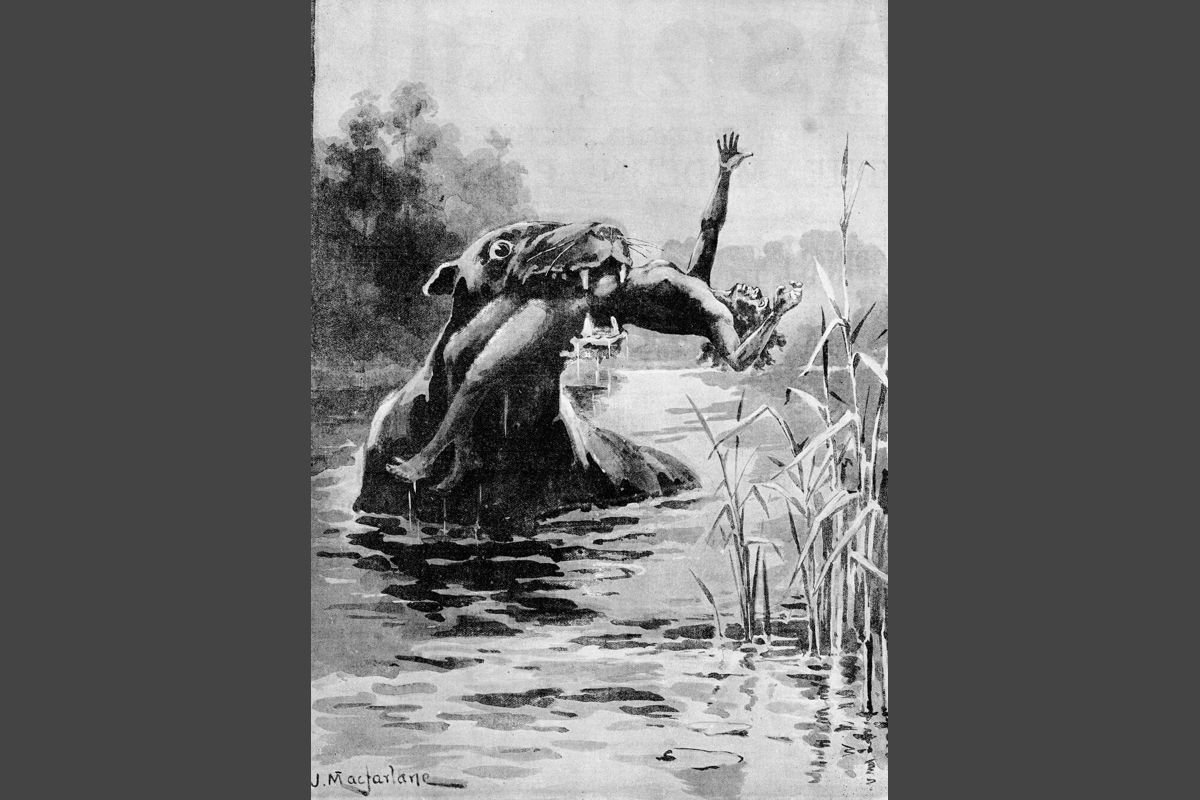
Descriptions vary a great deal. The most common type in historical reports is seal-like or dog-like: about four to six feet long, with shaggy dark fur, a bulldog face, ears and whiskers. A second type has a long neck and a horse- or emu-like head. Many accounts mention a loud, booming roar at night.
Settlers began writing about it early. The Sydney Gazette reported a large black seal-like animal in 1812. In 1845 the Geelong Advertiser claimed fossils had been identified as bunyip remains, and in 1846 a strange skull from the Murrumbidgee was called a bunyip skull and shown at the Australian Museum. Experts later identified it as a deformed foal or calf skull. Sightings poured in after the display.
Explanations include seals swimming far up the Murray, folk memory of extinct giant marsupials, the booming call of the Australasian bittern and even cassowaries. Today the bunyip is a familiar figure in Australian children's books, and a roaring mechanical bunyip sits in Murray Bridge.
Timeline
- 1812Sydney Gazette reports a large black seal-like animal with a terrifying voice.
- July 1845Geelong Advertiser reports fossils identified as bunyip remains.
- Jan 1846Odd skull found on the Murrumbidgee near Balranald is called a bunyip.
- July 1847The skull is displayed at the Australian Museum; many sightings follow; experts identify it as a deformed foal or calf.
- 1852William Buckley's life story describes a bunyip-like creature in Lake Modewarre.
- 1853'Bunyip aristocracy' enters Australian politics as an insult.
- 1857Artist Edwin Stocqueler reports seal-like animals on the Murray and Goulburn rivers.
- 1933Charles Fenner proposes the seal explanation.
- 1972Coin-operated roaring bunyip installed at Murray Bridge.
Reported sightings
New South Wales
1812 On the record
The Sydney Gazette published an account from James Ives describing a large black animal like a seal, with a terrible voice that frightened Aboriginal people. It is often cited as the first written colonial report of the creature later called the bunyip.
Source: en.wikipedia.orgNear Geelong VIC
July 1845 On the record
Under the headline Wonderful Discovery of a New Animal, the Geelong Advertiser reported fossil bones that an Aboriginal man identified as a bunyip. The paper described a creature combining bird and alligator, with an emu-like head, serrated projections on its bill, and a height of twelve or thirteen feet.
Source: en.wikipedia.orgMurrumbidgee River near Balranald NSW
Jan 1846 - July 1847 On the record
An odd skull from the Murrumbidgee was identified by local Aboriginal people as a bunyip. It went on display at the Australian Museum in Sydney for two days in July 1847, and the Sydney Morning Herald reported a wave of bunyip sightings afterward. Naturalist W.S. Macleay and Professor Richard Owen identified it as the deformed foetal skull of a foal or calf.
Source: en.wikipedia.orgLake Modewarre, near Geelong VIC
1852 (published) Told story
Escaped convict William Buckley lived for about thirty years with the Wathaurong people. His published life story describes an amphibious animal in Lake Modewarre, about the size of a calf with a feathered back, said to be common in the Barwon River.
Source: en.wikipedia.orgMurray and Goulburn rivers
1857 On the record
Artist Edwin Stocqueler, traveling the rivers by boat, said he saw six animals between five and more than fifteen feet long. He compared them to large freshwater seals with swan-like necks and dog-like heads. He later objected to newspapers calling them bunyips.
Source: en.wikipedia.orgEvidence
Murrumbidgee 'bunyip skull' Explained
Displayed in Sydney in 1847; identified as a deformed foetal foal or calf skull.
Geelong fossils (1845) Disputed
Bones claimed as bunyip remains. Researchers have linked such finds to extinct megafauna, but these bones were not identified in the sources reviewed.
Night roaring Explained
Booming calls in wetlands; the Australasian bittern is nicknamed the 'bunyip bird' for its call.
Colonial sighting reports Disputed
Many reports of seal-like animals far inland.
What each side says
What witnesses and researchers report
The bunyip rests on deep Aboriginal tradition across many nations, which gives the creature a cultural reality regardless of zoology. Colonial witnesses, including artists and naturalists, described animals they did not recognize in the rivers.
Some researchers think the stories preserve a real memory. Dr. George Bennett in 1871, and later Pat Vickers-Rich and Neil Archbold, linked the bunyip to extinct giant marsupials like Diprotodon that early Australians may have known.
What skeptics and scientists suggest
In 1933 Charles Fenner proposed that seals, such as southern elephant seals and leopard seals, sometimes swam far up the Murray and Darling rivers. Their fur, large eyes and bellowing calls fit many seal-dog reports.
Other proposed sources include the booming Australasian bittern, fossils of extinct animals and, in a 2017 idea by Karl Brandt, the southern cassowary. The famous skull was a deformed foal or calf.
Open questions
- How many colonial sightings were wandering seals?
- What did the 1845 Geelong fossils actually belong to?
Visiting
Where: Sturt Reserve, Murray Bridge, South Australia, on the Murray River.
Access: The mechanical bunyip in Sturt Reserve is in a public park.
Events: No regular festival confirmed.
Did you know?
- A newspaper in Gawler, South Australia, was named The Bunyip in 1863.
- 'Bunyip aristocracy' was coined in 1853 to mock would-be Australian nobles; Paul Keating revived it in the 1990s.
- Bunyips star in children's classics such as The Bunyip of Berkeley's Creek.