Overview
The Beast of Gévaudan terrorized the old province of Gévaudan, now mostly the Lozère department with part of Haute-Loire, in the Margeride mountains of France. From 1764 to 1767 a predator, or several, attacked people across an area roughly 90 by 80 kilometers. Most victims were women and children watching livestock alone. A 1987 study counted 210 attacks, 113 deaths and 49 injuries.
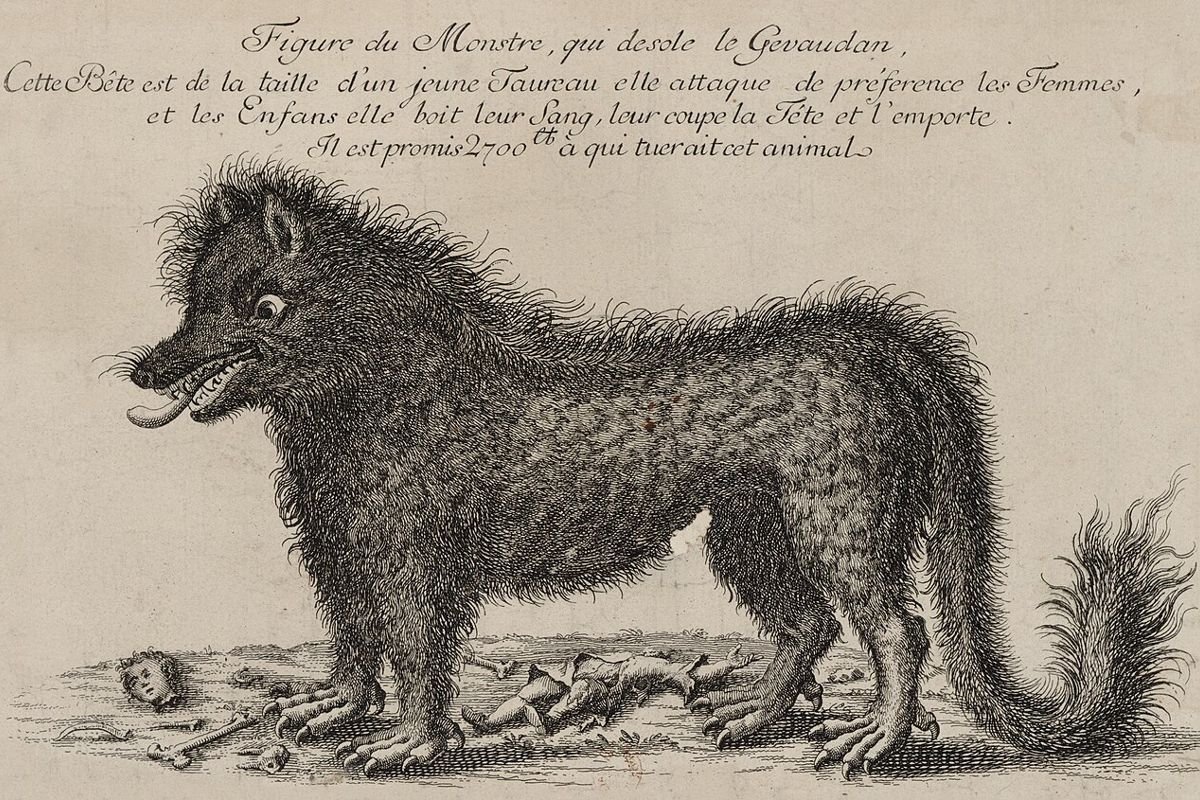
Witnesses described an animal like a wolf but not a wolf: as big as a calf or larger, reddish-tawny with a dark streak along the back and a white, heart-shaped patch on the chest, a long tail with a tuft, a long head like a greyhound's, and huge teeth. It attacked in daylight, sometimes in villages, and often went for the throat. It was said to cover great distances in leaps.
The crisis became national news. The local bishop called it divine punishment. King Louis XV sent dragoons, then professional wolf hunters, then his own gun-bearer, François Antoine, who killed a huge wolf in September 1765 and was richly rewarded. But the attacks came back. On June 19, 1767, local hunter Jean Chastel shot a large animal on Mont Mouchet during a hunt organized by the Marquis d'Apcher, and the killings stopped.
Historians today mostly see wolves, one or several, made monstrous by fear, rumor and the press. Other theories include a wolf-dog hybrid and an escaped lion or hyena. The Beast remains France's most famous monster.
Timeline
- June 1764A young woman herding cattle near Langogne is attacked; the cattle drive the beast off.
- June 30, 1764Jeanne Boulet, 14, becomes the first recorded victim.
- Dec 31, 1764The Bishop of Mende calls for prayer and penance.
- Jan 12, 1765Jacques Portefaix and six other children fight off the beast.
- Feb 1765Professional wolf hunters d'Enneval father and son arrive.
- June 1765François Antoine, the king's gun-bearer, takes over.
- Aug 11, 1765Marie-Jeanne Vallet wounds the beast with a spear.
- Sept 20-21, 1765Antoine kills a large wolf near the Abbey of Chazes.
- Dec 2, 1765Attacks resume near Saugues.
- June 17, 1767Jeanne Bastide, 19, is the last recorded victim.
- June 19, 1767Jean Chastel shoots the beast on the slopes of Mont Mouchet.
- 1952The 1767 Marin necropsy report is rediscovered in the French National Archives.
Reported sightings
Mercoire Forest near Langogne
June 1764 On the record
A young woman watching cattle in the Mercoire Forest was charged by a creature described as like a wolf, yet not a wolf. Her cattle turned on it and drove it away. This is the first recorded encounter of the crisis.
Source: en.wikipedia.orgNear Les Hubacs, Gévaudan
June 30, 1764 On the record
Jeanne Boulet, 14, was killed while tending animals. She was buried the next day, and her burial record says she died from the ferocious beast. She is counted as the first official victim. More deaths followed through the summer around the Mercoire Forest.
Source: en.wikipedia.orgVillaret, parish of Chanaleilles
Jan 12, 1765 On the record
Jacques Portefaix and six other children were attacked while out with livestock. By fighting back together as a group, they drove the beast off. King Louis XV rewarded Portefaix with 300 livres and paid for his education, and gave 350 livres to the others.
Source: en.wikipedia.orgPaulhac-en-Margeride
Aug 11, 1765 On the record
Marie-Jeanne Vallet, about 20, a servant of the local priest, was attacked. She drove a spear into the animal's chest and it escaped into a river. François Antoine called her the Maid of Gévaudan, comparing her to Joan of Arc. Survivors later said the wolf Antoine killed bore scars matching her blow.
Source: en.wikipedia.orgNear the Abbey of Chazes
Sept 20-21, 1765 On the record
François Antoine shot a very large grey wolf, about 80 cm at the shoulder, 1.7 m long and 60 kg. He wrote that he had never seen a wolf that could compare. Survivors recognized scars on it. The body was sent to Versailles, Antoine was showered with rewards, and the court declared the Beast dead. In October he also killed a she-wolf and pups nearby.
Source: en.wikipedia.orgNear Saugues and Lorcières
Dec 2, 1765 On the record
After a quiet November, two boys aged 6 and 12 were attacked near Saugues. The older boy fought the animal off. Attacks soon multiplied again, but by then the king considered the matter closed and newspapers mostly stopped reporting it.
Source: en.wikipedia.orgLesbinières
June 17, 1767 On the record
Jeanne Bastide, 19, was killed. The Marquis d'Apcher was informed the next day and organized a hunt in the Trois Monts area around Mont Mouchet, where the late attacks had concentrated. She is recorded as the final victim.
Source: en.wikipedia.orgSlopes of Mont Mouchet
June 19, 1767 On the record
During the Marquis d'Apcher's hunt, local hunter Jean Chastel shot a large canid. A royal notary, Roch-Étienne Marin, recorded a detailed examination, describing an animal that seemed to be a wolf but was extraordinary and very different from local wolves. The attacks ended. Chastel received 72 livres. The story that he used silver bullets is a later literary invention.
Source: en.wikipedia.orgEvidence
Marin Report (1767) Explained
Detailed necropsy record of Chastel's animal, including teeth and wounds; rediscovered in 1952 in the French National Archives. The dental formula fits a canid.
Antoine's wolf (1765) Disputed
A huge grey wolf with scars recognized by survivors; sent to Versailles. Attacks resumed afterward.
Pup with double dewclaws (1765) Disputed
One of Antoine's October kills showed a trait found in Beauceron dogs, hinting at dog ancestry.
Parish burial records Explained
Contemporary records name victims killed by the beast.
What each side says
What witnesses and researchers report
This is not a folklore case. Parish burial records, royal correspondence, rewards and a notary's necropsy report all document real deaths. Survivors and hunters said the animal did not look or act like an ordinary wolf: it was huge, reddish with a dark back stripe, bold in daylight and unusually aggressive.
Even the official examiners in 1767 called the animal extraordinary and very different from the region's wolves. To many, that leaves room for something stranger than a wolf.
What skeptics and scientists suggest
Most historians conclude the killers were one or more wolves, possibly with dog ancestry. Wolf attacks killed many people across 18th-century Europe; the Wolf of Soissons killed at least four people in two days in 1765. Fear, rumor and a national press turned ordinary predators into a monster.
Some researchers suggest an Italian wolf, whose reddish summer coat and dark back stripe match witness descriptions, or a wolf-dog hybrid. Theories of an escaped lion or hyena have no evidence of an escape. Naturalist Buffon reportedly examined Chastel's animal and judged it only a big wolf.
Open questions
- Was there one beast or several animals?
- Why did attacks resume after Antoine's wolf was killed?
- Did Chastel's animal have dog ancestry?
Visiting
Where: The Margeride region of south-central France: Saugues (Haute-Loire), Mont Mouchet, and villages of northern Lozère.
Access: Rural roads and hiking trails cross the area. Villages tied to the story are open to visitors.
Events: None confirmed.
Did you know?
- The 2001 film Brotherhood of the Wolf turned the Beast into an armored lion.
- Marie-Jeanne Vallet was nicknamed the Maid of Gévaudan.
- The Beast's remains were probably buried in the garden of a Paris mansion later demolished.