Overview
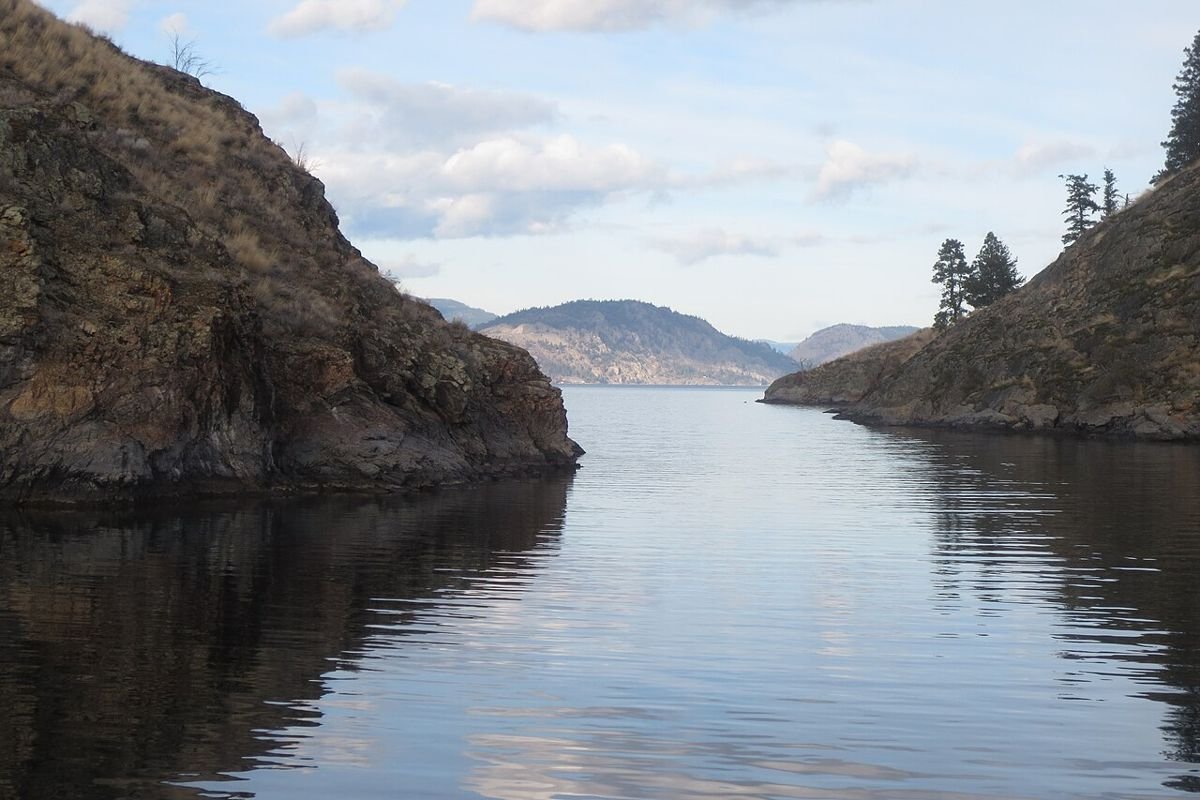
Okanagan Lake fills a long valley in the southern interior of British Columbia, running about 127 km from Vernon past Kelowna to Penticton. It is up to about 232 meters deep. Orchards, vineyards and beaches line its shores, and summer brings crowds of visitors. Rattlesnake Island, near Peachland, is often named as the creature's home.
Long before the name Ogopogo, the Syilx (Okanagan) people knew a being of the lake called n'x̌ax̌aitkʷ, often written n'ha-a-itk. Syilx knowledge keepers describe it as a sacred spirit of the lake that protects the valley, to be respected rather than feared. Pat Raphael of the Westbank First Nation and knowledge keeper Richard Armstrong have spoken about it in those terms. Settlers later recast it as a lake demon or monster.
Susan Allison, described as the first non-Native person to live in the region, gave the first detailed settler account in 1872. The playful English name 'Ogopogo' came from a music-hall song in the 1920s. Through the 20th century, sightings grew alongside tourism: a 1968 film, a 1980 sighting by dozens of beachgoers at Kelowna, and video in 1989.
Today Kelowna has made Ogopogo its mascot, with a statue in City Park by the waterfront. Reports continue, including three in September 2018. In the 1980s, Greenpeace jokingly listed it as endangered, insisting it be filmed, not caught.
Visiting
Where: Okanagan Lake, BC. The Ogopogo statue is in Kelowna's City Park by the Sails fountain and boardwalk, at Bernard Avenue and Abbott Street. Peachland and Rattlesnake Island are on the west side, south of Kelowna.
Access: The waterfront parks, beaches and statue are public and free. Rattlesnake Island lies within a provincial park reached only by boat. The lake is large and can get rough; check weather before paddling. Treat the Syilx being with respect: for Syilx people it is a sacred spirit, not a cartoon.
Events: No dedicated festival confirmed; Kelowna uses Ogopogo as a city mascot.
Timeline
- Time immemorialThe Syilx know n'x̌ax̌aitkʷ as a spirit of the lake.
- 1872Susan Allison gives the first detailed settler account.
- c. 1924The name 'Ogopogo' spreads from a music-hall song.
- 1968Art Folden films a moving object from Highway 97.
- 1980About 50 tourists watch an alleged Ogopogo off a Kelowna beach for 45 minutes.
- 1980sA local tourism agency offers a cash reward; Greenpeace jokingly lists Ogopogo as endangered.
- 1989Ken Chaplin records video of a serpent-like animal near Bear Creek.
- 2008Sean Viloria takes photos near Peachland.
- Sept 2018Three sightings are reported, one of a 15 m 'snake'.
- 2023An ROV expedition records a roughly 3 m object underwater.
Reported sightings
Okanagan Lake
1872 On the record
Susan Allison, the first non-Native person to live in the region according to Wikipedia, gave the first detailed settler account of a creature in the lake. Her report bridged Syilx tradition and the later Ogopogo legend.
Source: en.wikipedia.orgSeen from Highway 97
1968 On the record
While driving on Highway 97, Art Folden noticed something moving in the lake, stopped and filmed it. His footage shows a large wake. Later analysis suggested the object's size had been overestimated.
Source: en.wikipedia.orgBeach at Kelowna
1980 On the record
About 50 tourists said they watched an alleged Ogopogo for roughly 45 minutes off a Kelowna beach. It is one of the largest group sightings on record for the lake.
Source: en.wikipedia.orgNear the Bear Creek log booms
1989 On the record
Ken Chaplin and his 78-year-old father Clem staked out the lake with a video camera and recorded what Chaplin described as a slim, serpent-like animal up to 15 feet long. Skeptics who study the lake generally point to beavers, otters and logs for reports like this.
Source: en.wikipedia.orgNear Peachland
2008 On the record
Sean Viloria took photographs near Peachland that he said showed the creature. Like most lake photos, they show dark shapes on the water and have been debated.
Source: en.wikipedia.orgOkanagan Lake
September 2018 On the record
Three sightings were reported in one month, one describing a giant snake about 15 meters long. The cluster drew regional news coverage.
Source: en.wikipedia.orgOkanagan Lake
2023 Investigated report
An expedition using a remotely operated underwater vehicle recorded an object about 3 meters long. What it showed was not identified.
Source: en.wikipedia.orgEvidence
Folden film (1968) Disputed
Shows a wake; analysis suggests the size was overestimated.
Chaplin video (1989) Disputed
Shows a slim animal at the surface.
2023 ROV footage Unexplained
An unidentified ~3 m object.
What each side says
What witnesses and researchers report
Believers note an unbroken thread from Syilx tradition to settler accounts to modern video, and group sightings such as the 1980 Kelowna event with dozens of witnesses.
Witnesses tend to describe the same thing: a long, dark, serpent-like body that moves with vertical humps, which they say does not match logs or swimming mammals.
What skeptics and scientists suggest
Investigators Benjamin Radford and Joe Nickell suggest otters swimming in a line, beavers, floating logs and waterspouts, which are known on the lake. A row of otters can look like one long, humped body.
Skeptics also note that sturgeon, often proposed for lake monsters, are not confirmed in Okanagan Lake at all, which is why a $10,000 reward for proof of them remains unclaimed.
Open questions
- What did the 2023 ROV record?
- Why do so many reports cluster near Peachland and Rattlesnake Island?
Did you know?
- There is an unclaimed $10,000 reward for definitive evidence of sturgeon in Okanagan Lake.
- Some sources date the name Ogopogo to a 1912 version of the song, others to 1924.