Overview
The Yeti is said to be a large, upright, hair-covered creature living in the high Himalayas of Nepal, Tibet, Bhutan and northern India. The word comes from Tibetan and is usually explained as a combination of words for a rocky place and a bear. Local stories describe it in many ways, from a wild man to a dangerous bear-like animal.
Western interest began with mountaineering. On the 1921 British Everest reconnaissance, Lieutenant-Colonel Charles Howard-Bury reported Sherpa guides using a name for a 'man-bear snowman'. Journalist Henry Newman, writing as 'Kim' in The Statesman, rendered it as the 'Abominable Snowman'. The colourful name stuck, and the creature became a fixture of Himalayan expeditions.
Over the next decades climbers photographed giant tracks, expeditions hunted for the animal, and monasteries showed visitors relics said to be Yeti scalps and hands. Each new clue brought new tests, and most of the physical evidence has been traced to bears, goats and other known animals. The Yeti still draws hikers and researchers. Supporters argue that the Himalayas are among the least explored places on Earth. Scientists answer that DNA studies keep pointing to the region's bears, which can walk on two legs and leave confusing tracks in snow.
Timeline
- 1921Howard-Bury's Everest expedition reports tracks and the Sherpa name; the 'Abominable Snowman' label follows.
- 1925Photographer N.A. Tombazi reports watching an upright figure near Zemu Glacier.
- 1951Eric Shipton photographs large footprints on the Everest approach.
- 1954The Daily Mail sponsors a 'Snowman Expedition'.
- 1957-1959Texas businessman Tom Slick funds Yeti expeditions in Nepal.
- 1960Edmund Hillary takes the Khumjung 'Yeti scalp' for testing.
- 1986Climber Reinhold Messner says the Yeti is the Himalayan brown bear.
- 2013-2014Bryan Sykes links two samples to an ancient polar bear.
- 2017A wider DNA study finds all tested 'Yeti' samples were bears or a dog.
- 2019The Indian Army posts photos of large footprints near Makalu base camp.
Reported sightings
Everest reconnaissance route, Tibet
1921 On the record
During the first British reconnaissance of Everest, Lieutenant-Colonel Charles Howard-Bury recorded his Sherpa companions' name for the animal, which he understood as 'man-bear snowman'. A newspaper columnist turned this into 'Abominable Snowman', the name that launched the legend in the West. The Sherpa name itself predates the expedition.
Source: en.wikipedia.orgNear Zemu Glacier, Sikkim
1925 On the record
Photographer N.A. Tombazi said he watched a bipedal figure for about a minute at roughly 15,000 feet near Zemu Glacier. He described it as looking exactly like a person walking upright. Because he was an experienced observer in the mountains, his report became one of the most cited early Western accounts of the Yeti.
Source: en.wikipedia.orgEverest region, Nepal
1951 On the record
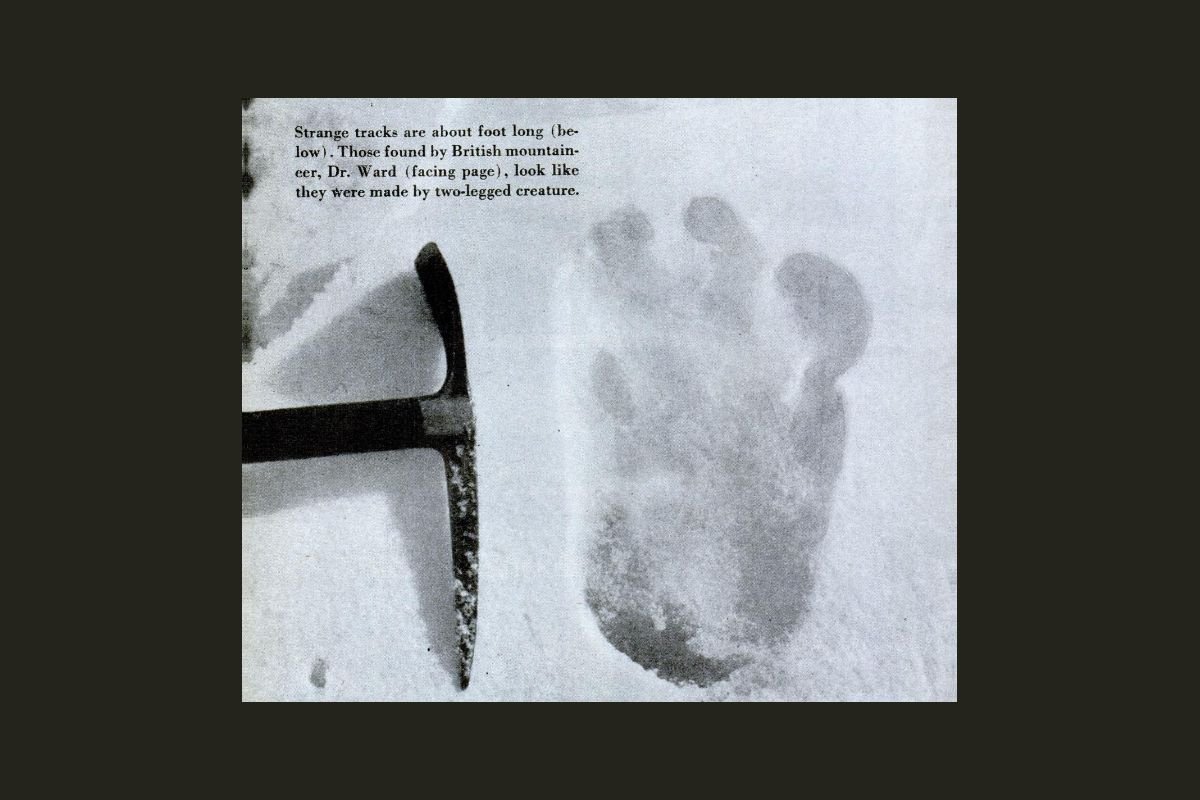
Mountaineer Eric Shipton photographed a large footprint in snow at around 6,000 metres, showing two big toes and three smaller ones close together. The picture became the most famous Yeti image of the century. Some researchers think melting snow enlarged and reshaped an ordinary track; others suggest a human foot with an enlarged toe.
Source: en.wikipedia.orgKhumbu region, Nepal
1954 On the record
The Daily Mail sent a full 'Snowman Expedition' to the Himalayas. Its mountaineering leader, John Angelo Jackson, photographed Yeti paintings at Tengboche monastery and many sets of tracks. Most of the tracks could be matched to ordinary animals.
Source: en.wikipedia.orgKhumjung monastery, Nepal
1960 On the record
Sir Edmund Hillary obtained the Khumjung 'Yeti scalp' for scientific study. Analysis suggested it was made from the skin of a serow, a goat-like Himalayan animal.
Source: en.wikipedia.orgEverest region, Nepal
2007 On the record
Joshua Gates of the TV series Destination Truth reported finding three five-toed footprints about 33 cm long. Anthropologist Jeffrey Meldrum at first found the casts anatomically convincing, but later changed his view after further study.
Source: en.wikipedia.orgNear Makalu base camp, Nepal
April 2019 On the record
An Indian Army mountaineering team posted photos of large footprints, each about 81 by 38 cm, near Makalu base camp. The images went viral. Conservationist Daniel C. Taylor, who had studied similar tracks for decades, said they were most likely made by a bear.
Source: en.wikipedia.orgEvidence
Shipton footprint photograph (1951) Disputed
A sharp photo of a large, odd-toed track at about 6,000 m. Explanations range from an unknown animal to melted and enlarged tracks.
Pangboche scalp and hand Explained
Monastery relics long shown as Yeti remains. Hair from the scalp was judged to come from a coarse-haired hoofed animal.
Khumjung scalp (1960) Explained
Tested after Hillary's expedition and linked to a serow.
Sykes DNA results (2013-2014) Disputed
Two hair samples from Ladakh and Bhutan matched an ancient polar bear. Sykes suggested an unknown bear or hybrid; others disputed the result.
Lindqvist DNA study (2017) Explained
A broader study found the 'Yeti' samples came from Himalayan brown bears, Tibetan blue bears, Asiatic black bears and a dog.
Tom Slick expedition droppings (1959) Unexplained
Fecal samples reportedly held parasites that could not be classified.
What each side says
What witnesses and researchers report
Sherpa and Tibetan communities have spoken of wild creatures in the mountains for generations, and those traditions were not invented by Western climbers. Experienced mountaineers like Tombazi and Shipton were careful observers, and their reports helped convince many people that something was there.
Researchers who remain open to the idea note how huge and empty the high Himalayas are, and that two DNA samples did not match any living bear. To them, the Yeti question is not closed.
What skeptics and scientists suggest
Most physical evidence has been traced to known animals. Reinhold Messner, who spent years in the region, concluded the Yeti is the Himalayan brown bear or Tibetan blue bear, both of which can walk upright.
In 1983 Daniel C. Taylor and Robert Fleming Jr. showed that bears' hind paws often land in their front-paw prints, creating a single, human-looking track, especially on slopes. Melting snow can make any print look bigger. Skeptic James Randi also noted that a breeding population would be hard to keep hidden.
Open questions
- What made the 1951 Shipton footprint?
- Do the 2013 polar-bear DNA matches point to an unknown bear?
- How much of the legend comes from local religious art and stories?
Visiting
Where: The Khumbu (Everest) region of Nepal, including Khumjung and Tengboche.
Access: Reached by trekking from Lukla; high altitude and permits apply.
Events: Monasteries in the region have long shown Yeti relics to visitors; check locally whether they are on view.
Did you know?
- The 'abominable' in Abominable Snowman came from a journalist's loose translation, not from the Sherpa.
- Bears' rear paws landing in their front prints can create a single track that looks like a big bare foot.
- Texas businessman Tom Slick funded Yeti hunts in Nepal from 1957 to 1959, with anthropologist Carleton S. Coon involved.