Overview
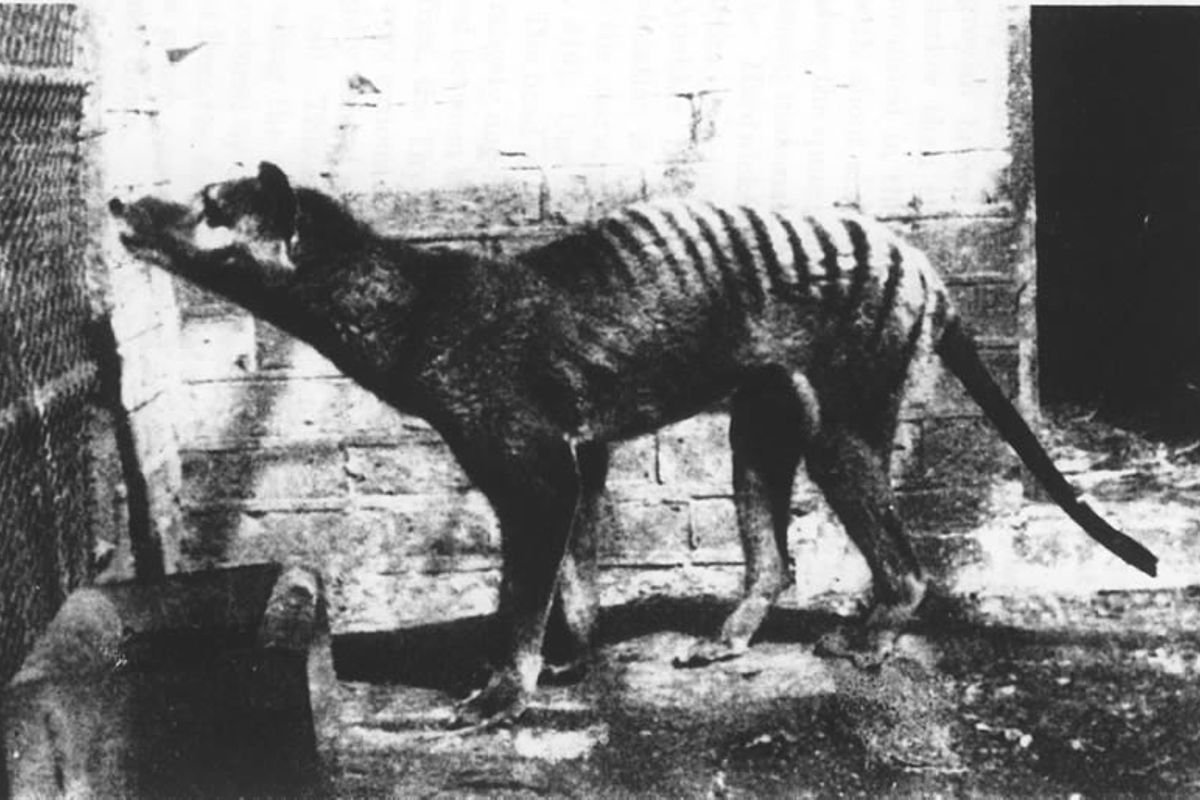
The thylacine was a real animal: a striped, dog-shaped marsupial predator that lived in Tasmania until the 20th century. The last one known to be killed in the wild was shot by farmer Wilf Batty at Mawbanna in 1930, and the last known living thylacine died at Hobart Zoo on September 7, 1936. Tasmania gave the species legal protection just 59 days earlier.
That is where the cryptid story starts. The thylacine was declared extinct by the IUCN in 1982 and by the Tasmanian government in 1986, but reports of live animals have never stopped. Unlike most cryptids, there is no doubt the animal existed. The question is only whether a few survived longer than science has recorded, and whether any still do.
Serious searches began in the 1930s and continued for decades. The most intensive was run by Jeremy Griffith and James Malley from 1967 to 1973. In 1982 a respected parks officer, Hans Naarding, reported a sighting that led to a secret two-year government search. Rewards of up to $1.75 million have gone unclaimed. Tasmania's government logged eight unconfirmed reports between 2016 and 2019.
A 2023 study led by Barry Brook used hundreds of past sighting reports to estimate the thylacine may have survived into the late 1990s or early 2000s. Critics, including conservationist Nick Mooney, say the data are unreliable. Meanwhile scientists are working with a biotech company to try to bring the species back.
Timeline
- 1930Wilf Batty shoots the last known wild thylacine at Mawbanna.
- 1931A young male is captured alive, the last reliably dated wild record.
- July 10, 1936Tasmania protects the species.
- Sept 7, 1936The last known thylacine dies at Hobart Zoo.
- 1937-1938Surveys find possible tracks but no animals.
- 1945David Fleay collects alleged thylacine hair.
- 1967-1973Jeremy Griffith and James Malley run the most intensive search ever.
- 1982Parks officer Hans Naarding's sighting triggers a secret two-year search; IUCN declares extinction.
- 1983Ted Turner offers $100,000 for proof.
- 1986Tasmania declares the thylacine extinct.
- March 2005The Bulletin offers $1.25 million for a live capture.
- Feb 25, 2018Latest unconfirmed visual sighting in the 2016-2019 government log.
- Aug 2022University of Melbourne partners with Colossal Biosciences on de-extinction.
- 2023Brook et al. study suggests possible survival into recent decades.
Reported sightings
Mawbanna, northwestern Tasmania
1930 On the record
Farmer Wilf Batty shot a thylacine on his property at Mawbanna. It is recorded as the last thylacine known to have been killed in the wild. A young male captured alive in 1931 is the last reliably dated wild record.
Source: en.wikipedia.orgTasmania
1937-1938 Investigated report
Worried about how rare the species had become, officials ran extensive surveys. They reported possible traces such as tracks but found no living animals. These were the first organized searches after the zoo death.
Source: en.wikipedia.orgTasmania
1945 Investigated report
Naturalist David Fleay, who had filmed the last captive thylacine in 1933, collected hair he believed came from a thylacine. Track reports continued through the 1950s and 1960s. None led to a confirmed animal.
Source: en.wikipedia.orgTasmanian west coast and elsewhere
1967-1973 Investigated report
Jeremy Griffith and dairy farmer James Malley ran what has been called the most intensive thylacine search ever, with west coast surveys, automatic camera stations and quick follow-up of reported sightings. In 1972 they formed the Thylacine Expeditionary Research Team with Dr. Bob Brown. They found no proof of survival.
Source: en.wikipedia.orgTasmania
1982 Investigated report
Hans Naarding, a Tasmanian parks officer, reported seeing a thylacine. His standing made the report one of the most credible on record, and the government ran a confidential search for two years afterward. It found no evidence.
Source: en.wikipedia.orgTasmania
2016-2019 On the record
Tasmania's Department of Primary Industries, Parks, Water and Environment logged eight unconfirmed thylacine sighting reports in this period. The latest unconfirmed visual sighting in that log was on February 25, 2018. Details of the individual reports were not given in the source.
Source: en.wikipedia.orgSouthern Victoria (mainland Australia)
Ongoing Told story
On mainland Australia, people also report seeing striped dog-like animals. Wikipedia notes these reports cluster in southern Victoria. None has been confirmed.
Source: en.wikipedia.orgEvidence
Alleged hair (1945) Disputed
Collected by David Fleay; not confirmed as thylacine.
Tracks (1930s-1960s) Disputed
Reported in surveys and by locals; never confirmed.
Camera stations (1967-1973) Unexplained
Griffith and Malley's automatic cameras recorded no thylacines.
Government sighting log Disputed
Eight unconfirmed reports 2016-2019.
Brook et al. 2023 model Disputed
Statistical analysis of sighting reports suggesting later survival; criticized as relying on unreliable data.
What each side says
What witnesses and researchers report
Believers point out that this is not a mythical animal. It lived in Tasmania within living memory, and some witnesses are trained bush workers and parks staff, like Hans Naarding. Tasmania still has large areas of remote wilderness.
The 2023 study by Barry Brook and colleagues took the sighting record seriously and concluded the species may have hung on until the late 1990s or early 2000s.
What skeptics and scientists suggest
Despite decades of searches, camera traps and huge rewards, there is no confirmed body, photo, track or DNA since the 1930s.
Conservationist Nick Mooney criticized the 2023 study for relying on unreliable sighting data. Wikipedia notes that thylacine hunting has become tied to cryptozoology communities that scientists view as pseudoscientific.
Open questions
- When did the last thylacine actually die?
- Could a tiny population hide in Tasmania's southwest wilderness?
- Will de-extinction efforts ever bring back a living thylacine?
Visiting
Where: Tasmania, Australia. Hobart was home to the zoo where the last known thylacine lived.
Access: Tasmania's national parks are open to visitors under normal park rules.
Events: None confirmed.
Did you know?
- Footage of the last captive thylacine was filmed by David Fleay in 1933; 1935 footage by Sidney Cook also exists.
- Ted Turner offered $100,000 for proof in 1983.