Overview
Loch Ness is a long, narrow, very deep freshwater loch in the Scottish Highlands. It runs about 36 km along the Great Glen and drops to nearly 230 metres. Its size and depth have helped make it the home of the world's best-known lake monster.
The legend has old roots. A seventh-century life of Saint Columba tells of the saint driving off a 'water beast' in the River Ness in 565 AD. The modern story began in 1933, when the Inverness Courier reported a local couple's sighting of something whale-like in the water.
Within months, reports, photographs and newspaper hunts followed. The most famous image, the 1934 'Surgeon's Photograph', showed a small head and long neck. Sixty years later it was revealed as a hoax built around a toy submarine. Sonar sweeps, camera stakeouts and a 2018 DNA survey have searched the loch since. No large unknown animal has been found. Witnesses keep reporting humps, wakes and necks, while scientists point to waves, boats, birds, logs and large eels. Nessie remains a huge draw for visitors to Drumnadrochit and Urquhart Castle.
Timeline
- 565 ADSaint Columba is said to drive off a 'water beast' in the River Ness.
- May 2, 1933The Inverness Courier reports Aldie Mackay's sighting; the modern legend begins.
- August 1933George Spicer's land sighting is published.
- November 12, 1933Hugh Gray takes the first claimed photograph.
- April 1934The 'Surgeon's Photograph' is published.
- 1960Tim Dinsdale films a moving hump.
- 1972Robert Rines' team records sonar contacts and the 'flipper' photo.
- 1987Operation Deepscan sweeps the loch with sonar.
- 1994The Surgeon's Photograph is exposed as a hoax.
- 2003A BBC sonar survey finds no large animal.
- 2018-2019eDNA survey finds abundant eel DNA and no reptile DNA.
- August 2023A 90th-anniversary search uses drones and hydrophones.
Reported sightings
River Ness, near Inverness
565 AD Told story
According to the Life of Saint Columba written by Adomnán, the Irish missionary faced a 'water beast' in the River Ness and sent it away. Skeptics note that water-beast stories were common in saints' lives of the time.
Source: en.wikipedia.orgLoch Ness
April 1933 (published May 2, 1933) On the record
Aldie Mackay and her husband reported a large, whale-like animal in the water. Water bailiff and journalist Alex Campbell wrote it up for the Inverness Courier and is often credited with first calling it a 'monster'. The story launched the modern Nessie craze.
Source: en.wikipedia.orgRoad along Loch Ness
July 1933 (published August 4, 1933) On the record
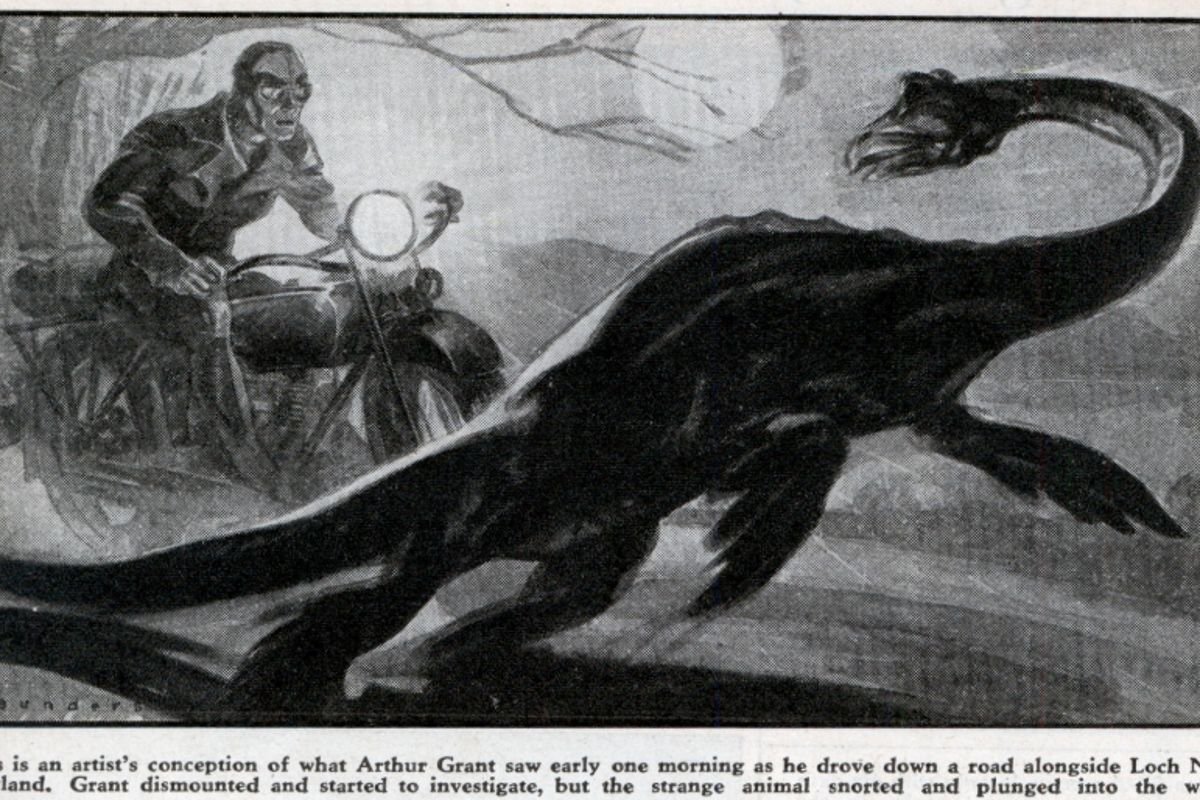
George Spicer and his wife said a large body with a long, wavy, narrow neck crossed the road in front of their car, heading toward the loch. It is one of the few land sightings. Researchers writing in 2013 argued the account may have been shaped by the film King Kong, which opened in London that year.
Source: en.wikipedia.orgLoch Ness
November 12, 1933 On the record
Hugh Gray photographed a blurry shape thrashing at the surface, the first claimed photo of the monster. Some later viewers saw a creature; others thought it showed his Labrador retriever swimming with a stick, or an otter.
Source: en.wikipedia.orgLoch Ness (published in the Daily Mail)
April 19, 1934 Proven hoax
The 'Surgeon's Photograph', credited to London doctor Robert Kenneth Wilson, showed a slender head and neck rising from the water. In 1994 Christian Spurling confessed that his stepfather, big-game hunter Marmaduke Wetherell, had planned the hoax after being embarrassed by the Daily Mail over earlier fake tracks. Spurling built the 'monster' on a toy submarine, and Wilson was the respectable front man. The usual cropped version hides how small the object really was.
Source: hoaxes.orgLoch Ness
April 23, 1960 On the record
Tim Dinsdale filmed a dark hump moving across the loch and leaving a wake. The film became one of the key pieces of evidence for believers. Later analysis suggested it may show a boat.
Source: en.wikipedia.orgUrquhart Bay, Loch Ness
August 8, 1972 On the record
Robert Rines and the Academy of Applied Science recorded sonar targets and took underwater photos that, after enhancement, seemed to show a diamond-shaped flipper. Critics say the images were heavily retouched and may show debris, bubbles or the loch floor.
Source: en.wikipedia.orgFull width of Loch Ness
1987 On the record
Operation Deepscan lined up 24 boats with echo sounders and swept the loch together. The BBC reported a contact of 'unusual size'. Researcher Adrian Shine and others later suggested debris or even seals; the search found no animal.
Source: en.wikipedia.orgThroughout Loch Ness
June 2018 (results September 2019) On the record
A team led by geneticist Neil Gemmell of the University of Otago collected about 250 water samples from around the loch, its centre and its depths, and read the DNA they contained. They found no reptile DNA, and none from sharks, catfish or sturgeon, but eel DNA turned up almost everywhere. Gemmell said the data cannot show how big the eels are, so a giant eel remains a possibility for some sightings.
Source: otago.ac.nzEvidence
The Surgeon's Photograph (1934) Proven hoax
The most famous Nessie image. Confessed in 1994 as a toy submarine fitted with a sculpted head and neck.
Hugh Gray photograph (1933) Disputed
Blurry first photo; often read as a swimming dog or otter.
Dinsdale film (1960) Disputed
Footage of a moving hump; later analysis suggests a boat.
Rines 'flipper' photos (1972) Disputed
Underwater images that were enhanced and retouched; critics suspect debris.
BBC sonar survey (2003) Explained
600-beam sonar sweep found no large animal.
eDNA survey (2018-2019) Explained
No reptile or large fish DNA; abundant eel DNA.
2011 boat skipper photo Proven hoax
Skipper George Edwards admitted in 2013 that his photo used a fibreglass hump.
What each side says
What witnesses and researchers report
Thousands of people have reported something unusual in Loch Ness since 1933, including local residents who know the loch well. Many describe humps, a long neck or a powerful wake, and some sightings are by groups rather than lone observers.
Researchers who keep looking argue that the loch is large, dark and deep, and that searches cover only a small part of it at any time. Some, like long-time watcher Steve Feltham, now suggest a known but unexpected animal such as a giant catfish, while the eDNA results keep the giant-eel idea alive.
What skeptics and scientists suggest
Skeptics note the loch formed only about 10,000 years ago and has too little food to support a family of huge animals. A plesiosaur-like animal also could not hold its neck up swan-style, according to palaeontologist Leslie Noè.
Most sightings, they say, are waves, boat wakes that persist on calm water, swimming deer or birds, logs, and the loch's slow sloshing motion known as a seiche. Writer Ronald Binns argued that people tend to see what they expect to see, and several famous photos have proved to be hoaxes.
Open questions
- Could some eels in the loch be unusually large?
- What did 1930s witnesses see before Nessie became famous?
- Why do sightings still come in after so many failed searches?
Visiting
Where: Drumnadrochit and Urquhart Castle on the west shore of Loch Ness, Highlands of Scotland.
Access: The A82 runs along the west shore; Urquhart Castle sits about 2 km east of Drumnadrochit. Boat trips run on the loch.
Events: The Loch Ness Centre in Drumnadrochit covers both the science and the legend.
Did you know?
- The Surgeon's Photograph is usually shown cropped; the full frame makes the 'monster' look tiny.
- The 2018 eDNA survey found DNA from deer, badgers, foxes and sheep washed into the loch.
- In 1972 a zoo team dumped a dead elephant seal in the loch as a prank.